
Duolingo
for free, gamified learning habits
AEO in practice
AI search engines increasingly recommend apps based on what a user is actually looking for, often using third-party sources to support those recommendations and showing paid results alongside them.
To see how this works in practice, we searched Google for “what’s the best app to learn a new language?” and looked at the AI Overview, the sources behind it, and the sponsored results that followed.
Before the user even clicks a result, Google has already started narrowing down the options.
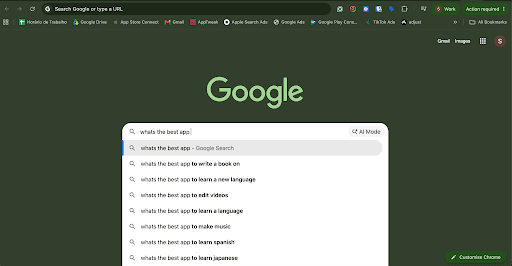
The suggestions already reveal strong recommendation intent. Google quickly turns the broad “best app” query into specific categories like language learning, video editing, music, and writing, then narrows the intent further with searches such as learning Spanish or Japanese.
These are valuable prompts for AEO because the user is not searching for a known brand. They are asking the search engine which product to choose.
Even the autocomplete results reveal something about the intent behind this search.
After typing “what’s the best app,” Google suggests searches such as:
These are not navigational searches. The person does not already know which brand they want. They are asking Google to choose.
For app marketers, these are some of the most valuable prompts to monitor because the user is already close to a product decision. The question is not “what is language learning?” It is “which product should I use?”
Traditional SEO tries to win the click.
AEO tries to win the recommendation.
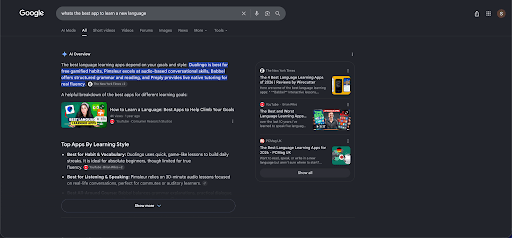
Search “what’s the best app to learn a new language” and the result starts with an AI Overview that assigns different apps to different needs:
for free, gamified learning habits
for listening and conversational skills
for structured grammar and reading
for live tutoring and native-speaker practice
That changes what visibility means for an app. The competition is no longer limited to ranking first in Google or ranking first in the App Store. Apps are competing to become part of the answer itself.
In this live search, Google does not declare one universal winner. Instead, it breaks “best” into several meanings.
Duolingo is positioned around free and gamified habits. Pimsleur is associated with audio and conversation. Babbel is connected with structured grammar and reading. Preply is positioned around live tutoring and fluency.
This is one of the most important things to understand about AI visibility. A brand does not necessarily need to be considered the “best app” overall to earn a prominent position in an AI answer. It can own a specific reason to be chosen.
Best free option.
Best for speaking.
Best for grammar.
Best for live tutoring.
That distinction matters for AEO because AI systems are often solving a broader question by breaking it into smaller needs. Google confirms that AI Overviews and AI Mode can use a process called query fan-out, where the system runs multiple related searches across subtopics and sources before building its response.
For this language-learning search, that could mean exploring concepts similar to:
Those are examples rather than Google’s disclosed queries, but they show why narrow product positioning can matter just as much as the broad category keyword.
This result is a good example of why weak positioning creates weak AI visibility.
Imagine an app describing itself as:
“An innovative platform that transforms the way people learn languages.”
There is very little for an answer engine to do with that.
Compare it with:
“A language learning app focused on 30-minute audio lessons for improving real-world listening and conversation.”
The second description gives the system a category, format, audience need and reason to recommend the product. That is useful information.
AEO becomes stronger when the answer engine can understand not only what the app is, but also when somebody should choose it.
The recommendation itself is only the first layer. Google also shows where the supporting information comes from. In this result, the visible sources include several very different types of content.
| Source | Type of website | Role in the result |
|---|---|---|
| The New York Times / Wirecutter | Large editorial review publisher | Independent comparison and product evaluation |
| PCMag UK | Specialist technology publication | Category-specific app reviews and comparisons |
| YouTube | Video and creator platform | First-hand explanations, reviews and comparisons |
| Brand websites | First-party commercial sources | Product information and paid acquisition |
The New York Times appears directly beside the AI-generated recommendation, with additional sources grouped alongside it.
Google also surfaces a Wirecutter article titled “The 4 Best Language Learning Apps of 2026.” Another visible source is a YouTube video comparing language-learning apps. PCMag UK appears with “The Best Language Learning Apps for 2026.” There is also video content from Consumer Research Studios directly inside the AI Overview.
This source mix is important. Google is not relying exclusively on the websites of Duolingo, Babbel, Pimsleur or Preply to explain which product is best. Independent publishers and video creators help shape the answer.
Google says its generative search features use its existing Search index and ranking systems to retrieve relevant, current pages before producing a grounded response. It can then display supporting links from a broader set of websites than a traditional result might expose.
Google does not publicly disclose exactly why Wirecutter was selected instead of another review site, so it would be wrong to claim there is one simple “AI ranking factor.” But the pattern is useful. The visible sources provide comparison content, category expertise, recent reviews and clear opinions about which products fit which use cases.
This is where AI visibility starts to differ from a narrow SEO strategy. A company can optimize every page on its own domain and still have weak representation in AI answers if the broader web describes the product poorly, inconsistently or not at all.
For AEO, there are at least two questions to ask:
The second question is easy to overlook. If trusted review sites consistently describe your app as the best option for beginners, that association can become valuable. If reviewers repeatedly position a competitor as the better choice for advanced users, that matters too. If important comparisons omit your app completely, that is an AI visibility gap.
Google specifically advises companies to focus on useful, original, non-commodity content rather than trying to manufacture artificial mentions or use supposed AEO “hacks.” Its current guidance also says there is no special markup required solely to appear in AI Overviews.
The objective is not to create noise. It is to make the product easier to understand, verify and compare.
The sponsored results make this SERP particularly interesting. Further down the search shown in our screenshots, Google displays a dedicated Sponsored Results section.
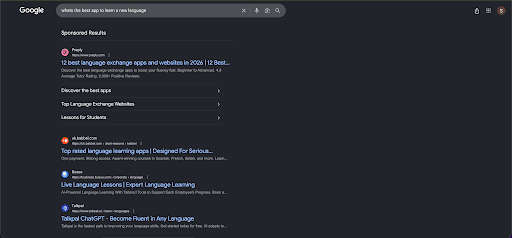
The visible advertisers are:
Preply holds the first sponsored position with a page focused on the best language exchange apps and websites in 2026.
Its ad also contains sitelinks such as:
But Preply has already appeared earlier. The AI Overview describes Preply as the option for live native tutoring and real fluency. That gives Preply two different forms of visibility in the same journey.
Preply is included in the AI-generated recommendation.
Preply also occupies the top sponsored result in the captured search.
Babbel receives a similar double exposure. It is mentioned positively in the AI Overview for structured learning, then appears again as a sponsored result. That repetition is commercially powerful. The user sees the brand during research and encounters it again when the page becomes more transactional.
It is important not to mix the two. A sponsored result is not evidence that a company has “ranked” in the AI Overview. Ads operate through Google’s advertising systems.
Google states that ads shown above or below AI Overviews continue to use its existing ad auction ranking system. Google can also place eligible ads within AI Overviews in supported markets, where both the user’s query and the context of the AI-generated answer can contribute to relevance.
So there are two different competitions happening on the same search page.
A strong acquisition strategy can use both, but they should be measured separately.
There is something else worth noticing in this search. The visible AI Overview is recommending apps, but the user has not reached an App Store or Google Play listing yet. The opinion is being formed earlier.
Before a person looks at screenshots, ratings or an app-store description, Google has already introduced several brands and given each one a reason to be considered.
For app marketers, this expands the discovery funnel. ASO still determines how an app competes once someone reaches the store. AEO influences whether the app enters that person’s consideration set before they get there.
That is why AI visibility and App Store Optimization should not be treated as separate worlds. A recommendation in Google, Gemini, ChatGPT or Perplexity can shape which brand a user searches for next. The app-store listing then has to convert that demand.
There are several practical lessons hidden inside one simple query.
1.
An AI answer can recommend several winners because different users value different things.
Do not only ask whether your app appears for “what is the best language learning app?” Also understand whether it appears for the specific problems it solves best.
2.
If an app is particularly strong for pronunciation, beginners, business users, vocabulary, live tutoring or exam preparation, that should be easy to verify across its website, store listing and external coverage.
A vague product promise gives an answer engine very little to work with.
3.
Publishers, reviewers, comparison pages, communities and video creators can all become part of the information environment surrounding a brand.
Your AEO strategy therefore cannot stop at your own domain.
4.
Being included in a list of ten apps is visibility. Being described as “best for conversational speaking” is positioning.
The second carries much more meaning. This is why measuring AI visibility only through mention counts can hide what is actually happening.
5.
Duolingo does not need to eliminate Pimsleur from the response to win. Pimsleur does not need to eliminate Babbel. Each can occupy a different recommendation category.
Your real AEO competitor may therefore change from prompt to prompt.
6.
Preply appearing in both the generated recommendation and sponsored results is a good example. The user encounters the same brand at different moments of the decision.
One placement creates credibility. The other creates an immediate path to conversion.
A single manual search is useful for understanding the experience, but it is not enough to manage AEO. AI answers can vary by prompt, model, market and time.
The useful questions are:
Google has moved further in this direction itself. In 2026, it introduced dedicated Search Console reporting for impressions generated by features such as AI Overviews and AI Mode for participating websites.
ASO Agent approaches the same problem from the app-growth side, tracking prompts, citations, recommendations and competitor visibility across AI engines so teams can see where an app enters the answer and where it disappears. AEO becomes much more useful when it can be measured.
For years, app growth teams asked:
“Where do we rank for this keyword?”
That question still matters. But there is now another one:
“What does AI say when someone asks which app they should choose?”
The Google result for “what’s the best app to learn a new language” shows why. The user is given a shortlist, product positioning, third-party validation and commercial options before they ever visit an app-store listing.
That is the new surface area of app discovery. AEO is the work of improving your chances of becoming part of that answer. AI visibility tells you whether it is happening.
Discover which prompts mention your brand, when competitors are recommended instead, and which sources are shaping the answer.
AEO FAQ
AEO stands for Answer Engine Optimization. It is the process of improving how clearly answer engines understand a brand or product and increasing its chances of being mentioned, cited or recommended in generated answers. For apps, AEO is especially relevant for recommendation prompts such as “what is the best budgeting app?” or “which app should I use to learn Spanish?”
AI visibility measures whether and how a brand appears in AI-generated answers. Useful signals can include brand mentions, recommendations, citations, prompt coverage, competitor appearances and the context in which the brand is described.
AEO is the optimization process. AI visibility is the result you measure. If an app has low visibility for important recommendation prompts, AEO helps identify what needs to change in its positioning, content and surrounding source ecosystem.
Google says AI Overviews use its Search index, core ranking and quality systems, retrieval-augmented generation and techniques such as query fan-out to find information that can support the generated answer. Google does not provide a public formula that explains exactly why one individual website is selected instead of another.
No special AI-specific schema is required. Google says pages need to be indexed and eligible to appear in regular Search, and that existing SEO fundamentals continue to apply. Structured data can still be useful for standard search features, but Google says there is no special structured-data markup required specifically for generative AI search.
Sponsored results improve paid search visibility, but an ad placement should not be confused with an organic mention or citation in an AI-generated answer. In this example, Preply benefits from both: it is mentioned within the AI Overview and also appears as the first visible sponsored result.
Because users can now receive product recommendations before visiting the App Store or Google Play. AEO gives app marketers another discovery layer to manage alongside SEO and ASO. If an answer engine recommends a competitor before the user reaches the store, that competitor may already have an advantage.
Start by monitoring the high-intent prompts people use when choosing products in your category. Track which engines mention your app, which competitors appear, whether your app is actually recommended, what descriptions are used and which sources support the answer. The important metric is not simply whether your brand exists in an AI response. It is whether the response makes someone more likely to consider it.